urban planning


Bengaluru’s story is one of constant reinvention, each phase of its growth leaving behind both progress and imbalance. In the 16th century, Kempegowda I established a mud fort surrounded by markets to support trade and economy. The British created a dual city structure with a military cantonment, prioritising greenery and planned spaces, but also entrenching spatial inequities. Expansion accelerated with the IT boom in the late 20th century, often outpacing governance and infrastructure capacity. New roads, buildings, and neighbourhoods emerged rapidly, straining infrastructure and depleting natural assets such as lakes and green cover.
Today, Bengaluru faces traffic congestion, limited public transport, insufficient civic amenities, and rising land prices. Affordable housing remains a challenge, while gentrification deepens socio-economic divides. Chronic water scarcity, driven by over-extraction and encroachments on lakes, further underscores the need for sustainable urban planning.
With its population projected to reach 20 million by 2031, Bengaluru’s rapid expansion has outpaced its capacity to plan equitably, testing how people live, move, and share space. As neighbourhoods rise and green spaces shrink, the need to rethink how the city grows has never been greater.
This page invites you to understand how Bengaluru looks at fixing infrastructural issues to emerge as a livable city for all, prioritising public spaces, mixed land use, tenure security and social justice.
Bengaluru’s Growth:
A snapshot
Built-up area: 87%
Green cover loss: 68% (1973) to 6% (2025)
Water spread loss (50 years): 79%
Vegetation loss (50 years): 88%
Wetland/ lake encroachments: 98%
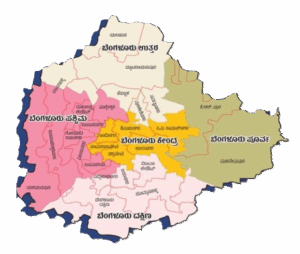
Greater Bengaluru
Authority
In September 2025, Bengaluru transitioned into a new urban governance system based on the Greater Bengaluru Governance Act, 2024. With this, there will be five city corporations, with the aim to harmonise planning, development and service delivery. The Corporations will be demarcated geographically and have its own Council, Mayor and Commissioner.
Scroll down to read more
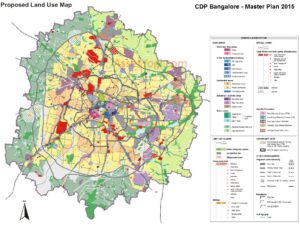
Regional Master Plans for the City
Bengaluru is the only Indian metro that lacks an updated master plan for the city. While the Master Plans are due to be revised at least once a decade, Bengaluru is still guided by RMP 2015! What does this mean for the city?
Scroll down to read more
Greater Bengaluru Authority
As of Oct 2025, Bengaluru is in the midst of a major change in city governance; being flagged as a first of its kind experiment for India. The erstwhile city corporation (BBMP) has now been replaced with the Greater Bengaluru Authority (GBA). The big change is the attempt to bring all parastatal agencies like BESCOM, BWSSB, BMTC, and BMRCL under the GBA.
The five City Corporations are proposed to have smaller wards and greater autonomy.
However, the fact that this move also involves bringing the city governance under State government control is being challenged in the courts. The much awaited Ward level elections (already delayed by over 5 years) are now due in 2026 and the subsequent functioning of the GBA will only play out in the coming months.
The Citizen Matters website offers an explainer to how the Greater Bengaluru Authority is organised and how it differs from the earlier version of city administration.
Regional master plans for the city
Bengaluru has a history of master plans for the city but the reality also is that it is the only metropolitan city that does not have an updated master plan.
At the National level, five-year plans are primarily related to sector-wise budget allocations. The states have a similar planning exercise with a thrust on land use and spatial planning; rather than socio-economic development. These spatial plans – variously referred to as Comprehensive Development Plans or Master Plans are typically prepared by parastatal agencies. In the case of Bengaluru this is the Bangalore Development Authority. What is also critical to note is that while the plan is made by the BDA, the execution has so far been with the BBMP.
In 1995, the Comprehensive Development Plan of 1995 (CDP 1995) was created which treated the city as a static entity. In 2003, the revision of this plan – now referred to as the Master Plan for Bangalore (RMP 2015) was outsourced to a private global consulting firm – the first time in India. The Final RMP 2015 was approved by the Govt of Karnataka in June 2007. While the Master Plans are due to be revised at least once a decade, Bengaluru is still guided by RMP 2015! In 2019, the BDA issued the Revised Master Plan 2031 (RMP 2031) – once again outsourced to an external agency, only to withdraw it in 2020. Bangalore still awaits a current Master Plan that takes into account current expansion, climate change and various other factors. The fallout of such a planning process is clearly evident when extreme weather events play out in our city – unfortunately a phenomenon that is growing in frequency. In the absence of a comprehensive decentralised plan, the city also faces the risk of various large infrastructure projects that are in complete conflict with ground realities.
What the city needs
Integrated Transport Planning
Expanding and improving public transport—metro lines, buses, and last-mile connectivity—can reduce congestion and improve accessibility. A shift to mass transit systems is essential for long-term urban resilience.
Green and Sustainable Infrastructure
Preserving and expanding green spaces, enforcing green building norms, and incentivizing rooftop gardens are crucial to restore Bengaluru’s ecological balance.
Community-Centric Development
Urban planning must be inclusive. That means involving communities in decision-making, upgrading existing neighbourhoods, and ensuring access to affordable housing.
Water Conservation and Regulation
Rainwater harvesting, lake rejuvenation, and strict controls on groundwater use are vital. Citizen participation and awareness campaigns can amplify efforts and ensure long-term impact.